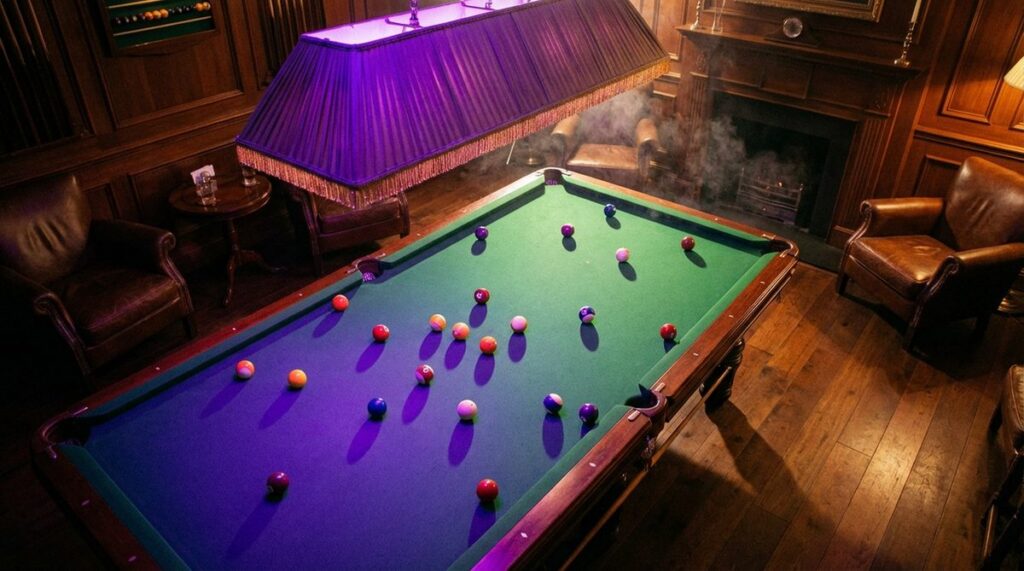
Walk into any pool hall in America and you’ll find the same scene: one person running the table with quiet confidence while everyone else watches and wonders how they make it look so easy. The secret isn’t talent — it’s fundamentals. Here’s how to stop being the one watching and start being the one playing.
The Grip and Stance
Hold the cue like a handshake — firm enough that it won’t slip, loose enough that your wrist can hinge freely. Your grip hand should be directly below your elbow when the cue tip is near the cue ball. Too far forward and you lose power. Too far back and you lose control.
Your bridge hand (the one on the table) is just as important. For a basic open bridge, spread your fingers on the felt, raise your knuckles slightly, and rest the cue in the groove between your thumb and index finger. Keep it stable — any wobble in the bridge shows up as a miss on the table.
Table Types You’ll Encounter
| Table | Size | Typical Setting | Pocket Size |
|---|---|---|---|
| Bar Box | 7 ft | Bars, casual venues | ~4.5 inches |
| Standard | 8 ft | Pool halls, home tables | ~5 inches |
| Tournament | 9 ft | Competitive play | ~4.5 inches |
| Snooker | 12 ft | Dedicated snooker clubs | ~3.5 inches |
Most entertainment centers run 7-foot bar boxes. The smaller table means tighter clusters and more bank shot opportunities. If you can play well on a bar box, a 9-footer will feel spacious.
8-Ball vs. 9-Ball: House Rules
8-Ball is what most people play. Solids (1–7) vs. stripes (9–15), pocket the 8-ball last. The one rule everyone argues about: do you have to call your shots? In league play, yes. In casual play, agree before the first break to save a fight later.
9-Ball is faster and more strategic. Balls are hit in numerical order (1 through 9), and the 9-ball wins the game regardless of when it drops — as long as you hit the lowest numbered ball first on each shot. Combos and caroms are legal and encouraged.
Essential Shots
- Stop shot: Hit the cue ball center with a firm, level stroke. The cue ball should stop dead where it contacts the object ball. This is the foundation of position play.
- Follow: Hit the cue ball above center. It rolls forward after contact. Great for getting to the other end of the table.
- Draw: Hit the cue ball below center with a smooth, accelerating stroke. The ball comes back toward you after contact. Takes practice but wins games.
- Bank shot: Object ball off a rail into a pocket. The angle in roughly equals the angle out, adjusted for speed and spin.
Position Play — The Real Game
Pocketing balls is half the battle. The other half is leaving the cue ball in a spot where your next shot is easy. Before every shot, ask two questions: where is this ball going, and where is the cue ball going after? If you don’t know the answer to the second question, you’re guessing — and guessing doesn’t run tables.
Pool Hall Etiquette
- Don’t stand in your opponent’s line of sight during their shot
- Place your cue vertically in a rack when not shooting — never lean it against the table
- Chalk your cue before every shot, but do it over the floor, not over the felt
- If you scratch, pull the ball out of the pocket and hand it to your opponent without commentary
- Losing gracefully is a skill. Slamming your cue on the table is not
Buying Your First Cue
A $30–50 two-piece cue from a reputable brand beats any house cue by a mile. Look for a straight shaft (roll it on the table to check), a decent tip (leather, not plastic), and a weight between 19 and 21 ounces. Once you have your own cue, your consistency jumps because you eliminate the variable of grabbing a different warped stick every session.