Dominate the Arena: A Player’s Handbook
Laser tag looks simple from the outside. Strap on a vest, grab a phaser, run around a dark arena shooting at flashing lights. But spend five minutes watching experienced players and you’ll notice something: they’re playing a completely different game. Positioning, timing, team coordination — the gap between a casual player and someone who actually knows what they’re doing is massive. Here’s how to close that gap.
Before You Enter the Arena
Preparation starts before the first beep. Wear dark clothing — black or navy works best. Bright colors and white shirts practically glow under blacklights, making you an easy target. Wear comfortable shoes with good grip. Arena floors can be uneven with ramps and turns, and the last thing you need is to slip during a sprint.
During the briefing, actually listen. Every arena has slightly different rules about sensor locations, recharge stations, and scoring multipliers. Some arenas award bonus points for hitting specific targets (base stations or shoulder sensors), and knowing this before the game starts gives you an instant advantage.
Movement: Stay Low, Stay Moving
The number one mistake beginners make is standing still. A stationary target is a dead target. But don’t just run aimlessly — move with purpose. Here are the key principles:
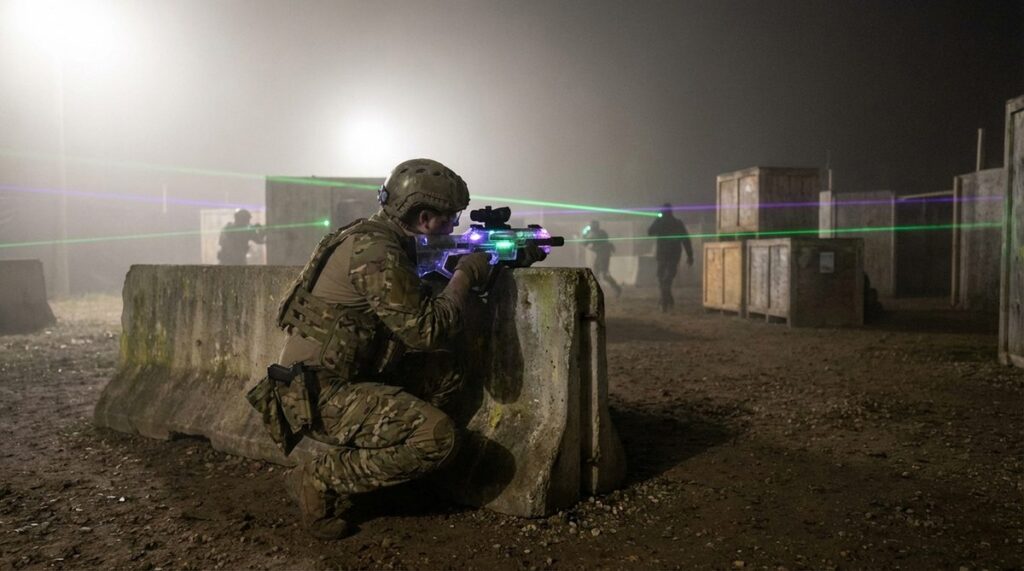
Crouch when shooting. This makes you a smaller target and stabilizes your aim. Most players shoot at chest height, so being lower automatically dodges a percentage of incoming fire.
Use strafing. When engaged in a firefight, sidestep while shooting instead of standing and aiming. Moving laterally is harder to track than someone running straight at you or away from you.
Never run backward. It feels instinctive to back away from an attacker, but you can’t see obstacles behind you and you’ll trip. Instead, break line of sight by ducking behind cover and repositioning.
Avoid the center. The middle of the arena is a kill zone. You can be shot from every direction with no cover. Stick to the walls and work the perimeter, cutting into the center only for quick strikes.
Positioning: Think Like a Sniper
The best laser tag players spend more time positioning than shooting. Look for elevated spots — ramps, raised platforms, or bridges give you a sightline advantage and make you harder to hit from below. Corners are your best friend; you can peek around them to fire, then duck back into cover before anyone can return fire.
Learn the arena layout in the first 30 seconds. Most arenas use the same design every session. Identify choke points (narrow passages everyone has to walk through), camping spots (positions with good cover and sightlines), and dead zones (corners with no tactical value where you’ll just get trapped).
Shooting: Accuracy Over Speed
Spraying shots everywhere feels productive but wastes your active time. Most laser tag systems have a brief cooldown after each shot or a limited “ammo” system that requires recharging. Make your shots count. Aim for center mass on the vest — the chest sensors are the largest target. If the system has shoulder or back sensors, flanking an enemy to hit their back target often scores double points.
Distance matters too. Infrared signals (what laser tag actually uses) have a maximum range, usually around 100 feet. At long range, your shot cone is wider and less reliable. Close to medium range engagements are more consistent.
Team Strategy: Communicate and Coordinate
In team games, coordination wins over individual skill every time. Here are strategies that work:
Buddy system: Pair up. One person pushes forward while the other covers. If the point person gets tagged, the backup picks off the attacker.
Pincer moves: When you spot an enemy, don’t both shoot from the same angle. One player engages while the other circles around to catch them from a different direction. Crossfire is devastating in laser tag.
Call out positions: Simple communication like “two players behind the tower” or “someone’s camping the bridge” helps your entire team adjust. Most casual groups never talk during the game — just doing this puts you ahead.
Protect your base: In capture-the-base modes, always leave at least one person on defense. An unguarded base is free points for the other team.
Advanced Tactics
The bait and switch: One player deliberately draws attention (running in the open, firing to give away their position) while teammates set up ambush positions nearby. When enemies converge on the bait, they walk into a trap.
Spawn camping awareness: After getting tagged, most systems deactivate your vest for 3 to 5 seconds. Smart opponents know where you’ll reactivate and will be waiting. After a respawn, immediately relocate before engaging again.
Sound discipline: Footsteps echo in arena environments. Experienced players walk softly and listen for opponents. If you hear someone running, you can position yourself for an ambush before they round the corner.
What Not to Do
Don’t cover your sensors. It’s cheating, and staff will call you out. Don’t physically grab or block other players. Don’t camp in one spot for the entire game — it’s boring for everyone and most arenas have anti-camping rules. And don’t take it so seriously that you stop having fun. Winning is great, but the best laser tag sessions are the ones where everyone’s laughing afterward.
Go Tag Somebody
With these strategies in your back pocket, you’ll notice an immediate difference in your scores and your enjoyment. Laser tag rewards smart play more than raw athleticism, which means anyone can dominate with the right approach. Now get out there, pick your spot, and start racking up points.