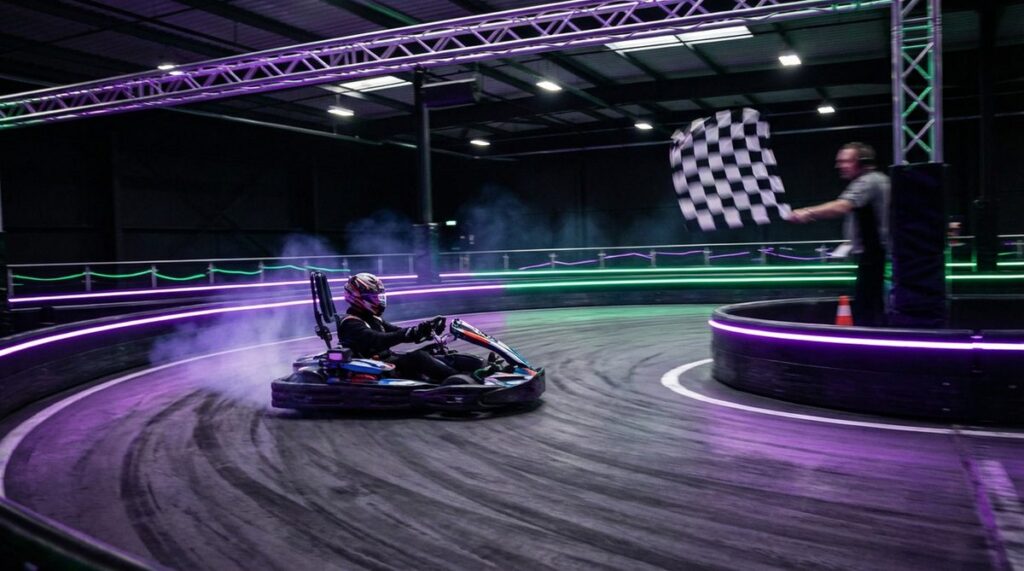
How to Shave Seconds Off Your Lap Time
Your first time in a go-kart is pure adrenaline. Your tenth time? That’s when you start wanting to actually be fast. Whether you’re racing at an indoor electric track or an outdoor gas-powered circuit, the fundamentals of going faster are the same. These tips won’t turn you into a Formula 1 driver overnight, but they will make you the fastest person in your friend group — and honestly, that’s what matters.
The Racing Line: Drive Less to Go Faster
The racing line is the path through a corner that lets you carry the most speed. The concept is simple: approach wide, turn in toward the inside (the apex), and exit wide. This straightens out the curve, which means less turning, which means more speed.
Think of it this way — a straight line between two points is always shorter than a curve. The racing line gets your path through a corner as close to straight as possible. On a go-kart track with multiple turns, nailing the racing line on every corner adds up to massive time savings.
Practice tip: look for tire marks on the track surface. The dark rubber trail from hundreds of previous drivers usually traces the optimal line. Follow it.
Braking: Less Is More
Beginners brake too much and too late. They approach a corner at full speed, slam the brake, slow way down, then accelerate out. Fast drivers do it differently: they brake early but gently, scrub just enough speed to make the corner, and get back on the throttle as soon as possible.
The key phrase is “slow in, fast out.” Enter the corner under control, hit the apex, and then floor it on the exit. The exit speed matters more than the entry speed because you carry that momentum all the way down the next straight. A corner where you exit 5 mph faster translates to being 5 mph faster for the entire following straight.
Throttle Control: Smooth Beats Aggressive
Slamming the gas pedal to the floor at every opportunity feels fast but isn’t. Especially in electric karts, which deliver instant torque, sudden throttle input can break traction on your rear tires, causing a slide that scrubs speed. Smooth, progressive throttle application keeps the tires gripping and the kart accelerating efficiently.
On straights, yes — full throttle. But through corners, modulate. Ease on the gas as you unwind the steering. By the time you’re pointing straight down the next section, you should be at full power.
Steering: Hands at 9 and 3
Keep your hands at the 9 o’clock and 3 o’clock positions on the wheel. This gives you maximum leverage and control. Avoid crossing your arms (hand-over-hand steering) — it’s slow and imprecise in a kart. Instead, push with one hand and pull with the other in a smooth motion.
Another beginner mistake: oversteering. If you turn the wheel too much, the front tires lose grip and the kart understeers (pushes wide). If the kart isn’t turning enough, the solution isn’t more steering input — it’s less speed into the corner.
Overtaking: Patience Wins
In a race with other drivers, the urge to pass immediately is strong. Resist it. Bad overtaking attempts (diving into corners too aggressively, forcing your way alongside on narrow sections) usually result in contact that slows both drivers down.
Instead, follow closely for a lap or two. Study where the driver ahead is slow — maybe they brake too early for a specific corner or take a bad line through a chicane. Set up your pass for a spot where you have a clear speed advantage and can complete the move cleanly.
The best overtaking spot is usually at the end of the longest straight, where drafting (following closely behind another kart to reduce air resistance) gives you a speed boost. Pull alongside them before the braking zone and take the inside line into the corner.
Body Position and Fitness
Sit upright with your back firmly against the seat. Slouching changes your center of gravity and affects how the kart handles. Keep your arms slightly bent — locked-out arms transmit every bump directly to your steering and tire you out faster.
Go-karting is more physically demanding than it looks. Your neck, shoulders, and forearms take a beating from G-forces and steering effort. If you’re planning to race multiple sessions, grip strength and neck stability make a real difference. Even casual stretching before you race helps.
Track-Specific Adjustments
Indoor tracks: Usually tighter with more technical corners. Focus on braking precision and slow-in-fast-out. Indoor surfaces can be slippery, especially on painted sections — be gentle with inputs.
Outdoor tracks: Generally faster with sweeping corners. The racing line becomes even more important on longer straights. Wind and weather conditions affect grip, so adjust your braking points accordingly.
Wet conditions: Some outdoor tracks run in light rain. Reduce speed significantly, brake much earlier, and avoid painted curbs and lane markings — they become ice-slick when wet.
Get Out There and Race
Go-karting rewards practice and consistency more than raw talent. Apply these fundamentals, focus on being smooth rather than aggressive, and you’ll see your lap times drop session by session. Most tracks display lap times on screens, so you get instant feedback. Chase your personal best, then start chasing everyone else’s.