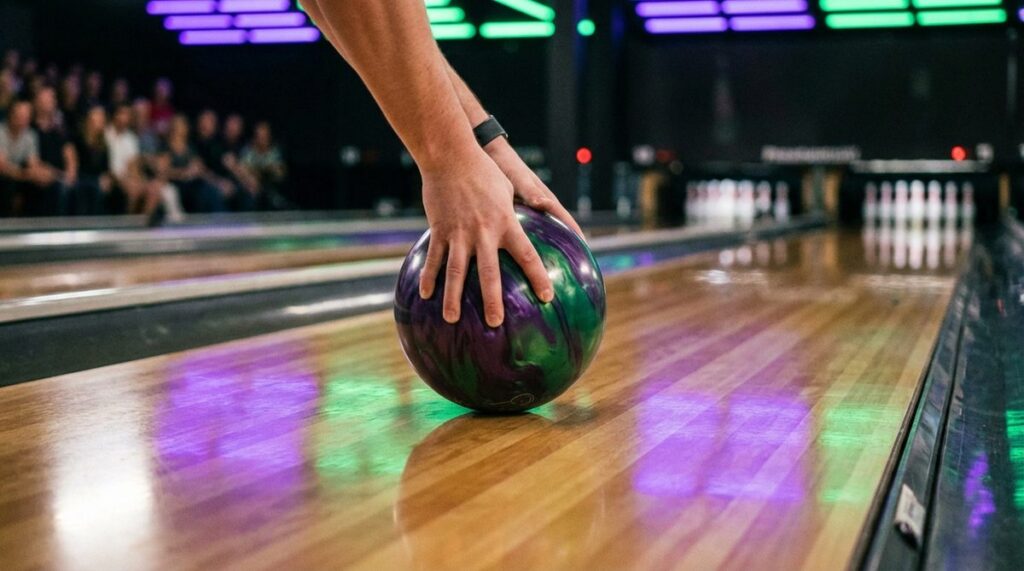
Everything You Need for Your First Strike
Walking into a bowling alley for the first time can feel a little intimidating. Rental shoes, confusing scoring screens, people throwing perfect curves three lanes over — it’s a lot. But here’s the thing: bowling is one of the most beginner-friendly sports out there. The basics take five minutes to learn, and you can genuinely improve in a single session. Let’s break down everything you need to know.
How Bowling Works: The Basics
A standard game of bowling consists of 10 frames. In each frame, you get two chances (called rolls or throws) to knock down all 10 pins at the end of the lane. If you knock them all down on your first roll, that’s a strike. If you get them all with both rolls combined, that’s a spare. The 10th frame has special rules — if you get a strike or spare, you earn bonus rolls.
Each game typically takes 10 to 15 minutes per player. So a group of four will finish a game in about 45 minutes to an hour.
Scoring Explained (Simply)
Modern alleys calculate your score automatically, but understanding the math makes the game way more interesting:
Regular frame: You score the total number of pins knocked down. Knock down 6 on your first roll and 3 on your second? That frame is worth 9.
Spare (/): You knocked down all 10 pins in two rolls. Your score for that frame is 10 plus whatever you knock down on your next roll. So if you spare and then roll a 7, that spare frame is worth 17.
Strike (X): All 10 pins on the first roll. Your score is 10 plus your next two rolls. Roll a strike followed by a 6 and a 3? That strike frame is worth 19.
Perfect game: 12 strikes in a row (including bonus rolls in the 10th frame) equals 300. Don’t worry about that for now — the average recreational bowler scores between 100 and 130.
Picking the Right Ball
House balls (the ones on the rack at the alley) come in weights from 6 to 16 pounds. Here’s a quick guide:
Kids under 10: 6-8 lbs
Teens and smaller adults: 10-12 lbs
Most adults: 12-14 lbs
Experienced bowlers: 14-16 lbs
The right weight is one you can swing comfortably without straining your arm or losing control. If the ball feels heavy when you hold it at chest height with one hand, go lighter. A lighter ball you control well beats a heavy ball that controls you.
For finger fit, your thumb should slide in and out easily (not too tight, not too loose) and your middle and ring fingers should fit snugly in the other two holes up to the second knuckle.
Your Approach: The Four-Step Method
Most bowlers use a four-step approach. Here’s how it works for right-handed bowlers (reverse for lefties):
Step 1 (right foot): Start with the ball at waist height. Push it forward and slightly down as you take your first step.
Step 2 (left foot): Let the ball swing down naturally beside your leg. Don’t muscle it — gravity does the work.
Step 3 (right foot): The ball swings back behind you. Keep your arm straight like a pendulum.
Step 4 (left foot): Slide forward on your left foot as the ball swings forward. Release the ball just past your ankle, close to the floor. Follow through with your arm pointing toward your target.
The slide on step four is important. Wear the rental shoes — they’re designed to let your slide foot glide on the approach while your other foot grips.
Where to Aim
Beginners instinctively stare at the pins. Don’t. Instead, look at the arrows on the lane about 15 feet in front of you. There are seven arrows arranged in a V shape. For a right-handed bowler aiming for a strike, target the second arrow from the right. This sends the ball into the “pocket” — the sweet spot between the head pin (the front one) and the pin just behind and to the right of it.
Hitting the pocket doesn’t guarantee a strike, but it gives you the best chance. Even if you leave a few pins standing, you’ll be set up for an easier spare.
Common Beginner Mistakes
Throwing too hard: Power isn’t the goal — accuracy is. A controlled medium-speed throw that hits the pocket beats a rocket ball that sprays pins everywhere. Slow down and focus on your target.
Gripping the ball: Death-gripping the ball tenses up your arm and kills your accuracy. Hold it firmly enough that it doesn’t slip, but relaxed enough that your thumb exits cleanly on release.
Crossing the foul line: That line at the end of the approach exists for safety — the lane surface beyond it is oiled and slippery. Step over it and you’ll eat floor. Automatic scoring systems also void your roll if you cross.
Ignoring spare shooting: Beginners obsess over strikes but ignore spares. Here’s a stat: if you pick up every spare, you’ll easily score over 150 without a single strike. Spares are where consistency lives.
Bowling Etiquette: Don’t Be That Person
A few unwritten rules keep things smooth at the alley:
Let the bowler on the lane next to you go first if you both step up at the same time. Don’t walk in front of someone who’s about to throw. Keep your feet off the approach area when you’re not bowling. And please, don’t loft the ball — that means throwing it so it lands with a thud halfway down the lane. It damages the lanes and annoys everyone around you.
Ready to Roll
Bowling is one of those rare activities where you can have a blast on day one and still be finding ways to improve years later. Grab some friends, rent some shoes, and don’t stress about your score. The gutter balls make for better stories anyway. Once you’ve got the basics down and want to take your game further, consider joining a casual league — most alleys run them weekly, and they’re a surprisingly great way to meet people and sharpen your skills.