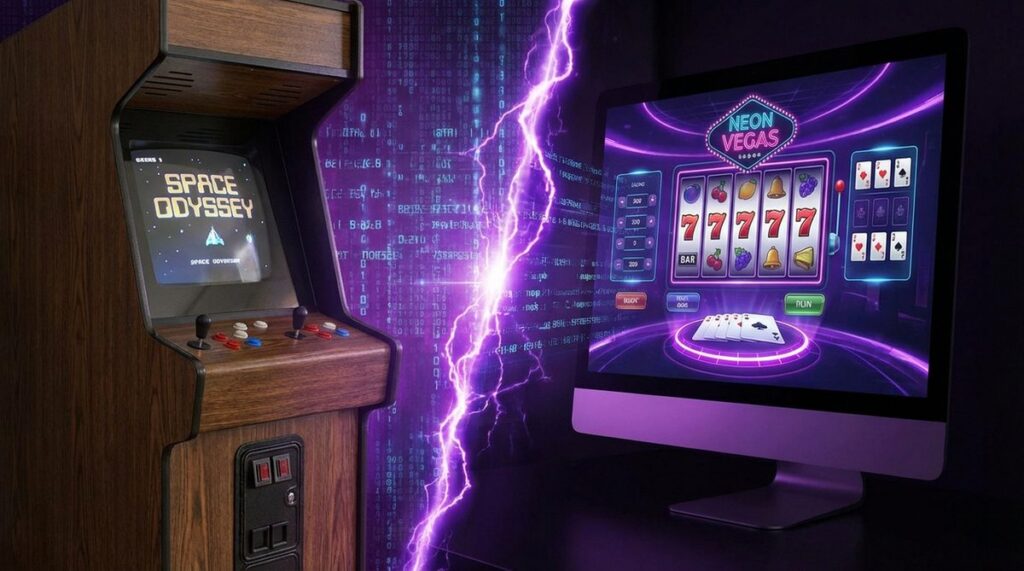
How Quarter-Munching Cabinets Became a Global Digital Industry
Stand in a modern arcade and you’re looking at the ancestor of a trillion-dollar global industry. The same dopamine hit that kept kids feeding quarters into Pac-Man in 1980 now drives everything from mobile gaming apps to competitive esports arenas to online casinos. The evolution from physical cabinets to digital platforms is one of the most dramatic shifts in entertainment history — and it happened faster than anyone predicted.
The Golden Age: Arcades Rule (1978-1985)
Space Invaders kicked the door open in 1978, and by the early ’80s, arcades were pulling in more revenue than the entire film industry. Every shopping mall had a dim room full of glowing screens and the constant soundtrack of digital bleeps. Games like Pac-Man, Donkey Kong, and Galaga weren’t just entertainment — they were cultural phenomena. Kids didn’t just play; they competed for high scores, developed strategies, and built communities around their local arcade.
The business model was beautifully simple: design a game hard enough that players lose quickly, but fair enough that they always feel like “one more quarter” will get them further. That psychological hook — easy to start, difficult to master, always just one more try — became the foundation for every gaming format that followed.
Home Consoles: The First Migration (1985-1995)
The Nintendo Entertainment System, Sega Genesis, and later the PlayStation brought arcade-quality gaming into living rooms. Suddenly you didn’t need quarters — you bought the cartridge and played unlimited. The arcade business model had to adapt. Cabinets got bigger, more physical (racing seats, light guns, dance pads), offering experiences you couldn’t replicate at home.
But the shift was irreversible. Gaming was moving from public spaces to private ones, from shared experiences to individual ones. The social element of the arcade — standing around a cabinet, watching someone attempt a world record — was being replaced by the solitary glow of a bedroom TV.
The Internet Changes Everything (1995-2010)
Online multiplayer reconnected gamers. What started with dial-up PC games like Quake and StarCraft evolved into the massive online worlds of EverQuest, World of Warcraft, and Xbox Live. Suddenly, gaming was social again — but the community was global instead of local.
This era also birthed online gambling platforms. The same technology that let you play Counter-Strike with someone in Sweden enabled real-money poker, slots, and table games through your browser. The gaming industry and the gambling industry, which had always shared DNA (both fundamentally about risk, reward, and the thrill of competition), found themselves converging in digital space.
Mobile and Free-to-Play: Gaming Goes Everywhere (2010-2020)
Smartphones put a gaming device in every pocket. Angry Birds, Candy Crush, and Clash of Clans proved that billions of people would play games if the barrier to entry was zero. The free-to-play model — give the game away, monetize through in-app purchases — echoed the arcade quarter model in a new wrapper. Pay a little to play a little more, unlock something new, or get another life.
Online entertainment platforms adopted similar approaches. Free access with premium options, loyalty programs, daily bonuses — the mechanics that keep players engaged across mobile games and online gaming platforms are remarkably similar because they’re built on the same psychological principles that filled arcades 40 years ago.
Where It All Stands Now
Today’s gaming landscape is a sprawling ecosystem. Physical arcades still exist — modernized with VR, redemption games, and social atmospheres. Console gaming is bigger than ever with the PS5 and Xbox Series X. PC gaming thrives through Steam and competitive esports. Mobile gaming generates more revenue than console and PC combined. And online entertainment platforms, from gaming sites to streaming services, capture billions of hours of attention annually.
The throughline from 1978 to now? People want to play. They want challenge, reward, competition, and community. The medium changes, the platforms evolve, the graphics improve — but the core human drive is identical to the kid who slid a quarter across the counter at the arcade in 1982.
The Future Is Everywhere
VR, AR, cloud gaming, and AI-driven experiences are the next frontier. The line between physical and digital entertainment continues to blur. Modern entertainment centers already combine physical activities with digital scoring, app-based experiences, and online leaderboards. The arcade of the future might not have cabinets at all — but it’ll still have that same fundamental magic of dropping into a game and losing yourself for a while.